⚡ Quick Answer
Screen printing is best for large orders of simple designs at the lowest cost per piece. DTG (Direct-to-Garment) suits small runs and photo-realistic artwork on cotton. DTF (Direct-to-Film) is the most versatile — it works on virtually any fabric, supports full colour, and scales from single pieces to mid-size runs without sacrificing quality. For most small businesses and organizations across the GTA in 2026, DTF hits the sweet spot of flexibility, speed, and value.
Custom apparel is one of the most powerful branding tools a small business, sports team, or community organization can invest in — and yet, the number of questions we receive every week at our Scarborough, ON studio about which printing method to use tells us that most buyers are genuinely confused before they even place an order. That confusion is understandable. The industry has changed fast. Screen printing has been around for decades. DTG matured through the 2010s. And DTF — Direct-to-Film — arrived as a legitimate game-changer that most buyers have only heard of recently. All three can produce stunning results. All three can also be the wrong choice if you pick without understanding what each method actually does.
This guide is built to cut through the noise. We work with entrepreneurs, nonprofits, retail brands, and corporate teams across the Greater Toronto Area every single week, and we have seen first-hand what happens when someone chooses the wrong method — reprints, delays, and budgets blown. By the time you finish reading, you will know exactly which method fits your project, your fabric, your quantity, and your deadline. Let’s get into it.
What Is Screen Printing — and When Does It Actually Win?
Screen printing is the undisputed champion for high-volume, simple-design orders where cost per unit matters most. If you are ordering 48 or more pieces of a two-colour logo on standard cotton tees, screen printing will almost always deliver the lowest price per shirt and the most vibrant, durable ink application of any method available.
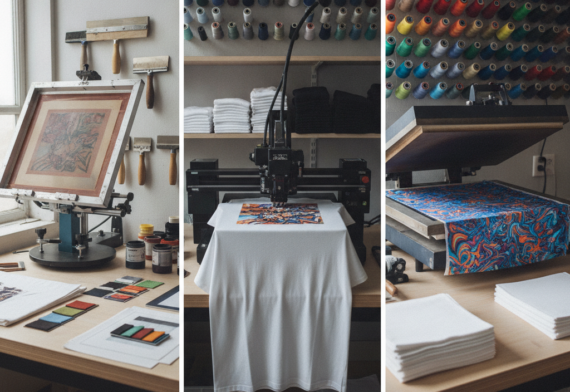
The process works by pushing ink through a mesh screen — one screen per colour — directly onto the fabric. That layered ink sits on top of the garment and cures under heat, creating a result that holds up wash after wash. For businesses ordering uniforms, event shirts, or promotional gear in bulk, that durability is a genuine competitive advantage over other methods.
Where screen printing struggles is complexity and quantity. Each colour in your design requires its own screen, which means setup costs are real. A five-colour gradient logo that looks gorgeous on a business card becomes a significant cost multiplier in screen printing. Quantities under 24 pieces rarely justify those setup fees, making screen printing economically awkward for small or one-off runs. Searching for screen printing near me or specifically toronto screen printing will surface dozens of providers — but not all of them will walk you through whether screen printing is actually the right call for your specific project. We do.
Screen printing also has fabric limitations. It performs beautifully on 100% cotton and standard cotton-poly blends, but on performance fabrics, moisture-wicking synthetics, or stretchy athletic wear, the results can crack or peel over time. If your team is outfitting athletes or staff in technical gear, keep reading — DTF is likely your better answer.
“Screen printing delivers the lowest cost per unit at volume — but it is the wrong tool when your design is complex, your order is small, or your fabric is anything other than standard cotton.”
Screen Printing: Best-Fit Scenarios
- Orders of 48+ identical pieces
- Designs with 1–4 solid colours and clean edges
- Standard cotton or cotton-poly garments
- Long-term uniform or merch programs where durability is paramount
- Tight per-unit budget with flexible lead time
How Does DTG Printing Work — and Is It Right for Your Order?
DTG — Direct-to-Garment — printing works exactly the way it sounds: a specialized inkjet printer applies water-based ink directly to the fabric surface, pixel by pixel, without screens or transfers. The result can be strikingly photographic, with gradients, shadows, and full-colour artwork reproduced with precision that screen printing simply cannot match at low quantities.
DTG is the go-to solution for print-on-demand, custom one-offs, and small runs where every piece might be a different design. Think of an artist selling limited-edition tees, a nonprofit creating personalized fundraiser shirts, or an entrepreneur testing five different colourways of a logo before committing to a large order. DTG removes the minimum quantity barrier entirely.
The limitation that consistently catches buyers off guard is the fabric requirement. DTG ink bonds best with 100% cotton — specifically pre-treated, light-coloured cotton. Printing on dark garments requires a white underbase layer, which adds time and can slightly affect the softness of the finished feel. On polyester, nylon, or performance blends, DTG ink struggles to adhere and often produces faded or washed-out results, even after proper curing. If you are sourcing custom t shirts canada-wide and your designs are going on mixed-fabric uniforms or technical wear, DTG is not your friend.
Cost per unit in DTG is higher than screen printing at volume and roughly comparable to DTF for small runs. Where DTG earns its place is in the combination of zero setup fees and photographic colour fidelity on cotton. If your artwork is complex and your quantity is low, DTG delivers results that would be prohibitively expensive with screens.
DTG Printing: Best-Fit Scenarios
- Small runs of 1–24 pieces with complex, full-colour artwork
- Print-on-demand fulfillment where designs change per order
- 100% cotton garments, preferably light-coloured
- Photographic prints, fine details, and gradient-heavy designs
- Situations where setup cost elimination matters more than per-unit price
Why DTF Has Become the Most Flexible Option for Canadian Custom Apparel
DTF — Direct-to-Film — is now the fastest-growing apparel decoration method in Canada, and for good reason: it solves the core limitations of both screen printing and DTG simultaneously. DTF works by printing your full-colour design onto a specialized film, applying a hot-melt adhesive powder, curing it with heat, and then heat-pressing the finished transfer directly onto the garment. The bond is remarkably durable, the colour reproduction is vivid, and the substrate compatibility is nearly unlimited.
DTF prints equally well on cotton, polyester, nylon, canvas, denim, leather, and blended fabrics. It handles dark garments without a separate underbase step. It supports gradients, fine lines, and photographic artwork without the colour separation complexity of screen printing. And it scales gracefully — from a single custom hoodie all the way to mid-size runs of 100 to 200 pieces — without the per-colour setup costs that make screen printing expensive at low quantities.
For the small businesses, sports organizations, and community groups we serve across the GTA, DTF has become the default recommendation for most branded apparel projects. A restaurant group in Scarborough ordering 30 staff shirts in two different styles? DTF. A startup distributing co-branded gifts for a product launch? DTF. A hockey association needing player numbers and logos on performance jerseys? DTF. The versatility is genuinely hard to overstate.
One honest caveat: at very high quantities — think 200 or more identical pieces with a simple two- or three-colour design — screen printing may still win on per-unit cost. DTF does not eliminate screen printing; it simply serves a far wider range of projects that screen printing was never built for. At Print Grafix, we assess each project individually and recommend the method that actually serves your outcome — not the one that is easiest to run on our end.
“DTF printing works on virtually any fabric, supports full-colour artwork without setup fees, and delivers wash-durable results — making it the most versatile option for most Canadian custom apparel buyers in 2026.”
Side-by-Side Comparison: Screen Printing vs. DTG vs. DTF
To make the decision straightforward, here is how the three methods stack up across the factors that matter most to GTA buyers — quantity, fabric compatibility, colour complexity, durability, and turnaround.
| Factor | Screen Printing | DTG | DTF |
|---|---|---|---|
| Minimum Quantity | 24–48+ pieces | 1 piece (no minimum) | 1 piece (no minimum) |
| Best Cost Per Unit | Excellent at high volume | Moderate; higher at scale | Competitive across ranges |
| Fabric Compatibility | Cotton & cotton-poly blends | Cotton only (best on light) | Almost any fabric |
| Colour Complexity | Limited by colour count | Unlimited / photographic | Unlimited / photographic |
| Setup Costs | Yes — per colour screen | None | None |
| Dark Fabric Printing | Yes (with flash curing) | Yes (requires underbase) | Yes (no underbase needed) |
| Wash Durability | Excellent | Good (varies by pre-treat) | Excellent |
| Turnaround Speed | Slower (setup required) | Fast for small runs | Fast across all quantities |
How to Choose the Right Method for Your Specific Project
Choosing the right print method is less about which technology sounds most impressive and more about matching the method to the reality of your project. The right answer shifts depending on four key variables: how many pieces you need, what fabric you’re printing on, how complex your artwork is, and how quickly you need the finished garments in your hands.
If you are producing bulk uniforms or event merchandise at 100 or more pieces with a clean, two- or three-colour logo on standard cotton, screen printing is almost certainly your most cost-effective path. The per-unit economics are simply difficult to beat at that scale when the design is simple. Ask any experienced printer — the math is straightforward.
If you need ten custom hoodies for a team retreat, each with an individual name or number, and the design includes a gradient or full-colour logo — DTF. No screens, no minimums, no compromises on fabric type, and a turnaround that actually works for your timeline. For many of the small and medium businesses we work with across Scarborough and the wider GTA, this scenario describes exactly what they need several times a year.
If your project involves high-resolution photographic artwork on 100% cotton tees in small quantities — say, an artist printing a limited run of gallery merch — DTG may offer the most faithful colour reproduction at the lowest entry cost. The key is confirming your garment is cotton, your colours are verified for DTG output, and you have allowed for the pre-treatment step in your timeline expectations.
As a full-service canadian custom apparel provider based in Scarborough, ON, our team at Print Grafix works through this decision with every client before a single file is submitted. We ask about the garment, the design, the quantity, and the deadline — and we recommend accordingly. That consultation is part of what separates a local studio from an online print platform where you click a dropdown and hope for the best.
A Practical Decision Framework
Walk through these questions in order before committing to a method:
- What fabric are you printing on? If it’s not 100% cotton, DTF is your safest bet. If it is cotton, all three methods are viable and you move to the next question.
- How many pieces are you ordering? Under 24 pieces — DTG or DTF. 25 to 100 pieces — DTF is often the most flexible and affordable. Over 100 identical pieces — screen printing may win on cost.
- How complex is your design? More than four colours or any gradients? Eliminate screen printing unless your quantity makes it worth the setup cost. DTG or DTF handles full colour with no surcharge.
- What is your turnaround requirement? Screen printing requires screen preparation and can push timelines out. DTF and DTG generally offer faster production once files are approved.
- What is your per-unit budget? Be honest about this. A tight per-unit budget at high quantity points to screen printing. A tight total budget at low quantity points to DTF to avoid setup fees.
Our team is always happy to walk through this framework with you directly — and in most cases, we can give you a clear recommendation within a single conversation. We have been doing this long enough to know that the right guidance upfront saves everyone time, money, and the frustration of redoing an order.
Beyond apparel, it is worth noting that our Scarborough studio handles a full range of branded print needs — from marketing and advertising prints to business essentials, signage, and large format work. If your apparel project is part of a broader brand refresh or product launch, we can coordinate everything from the garments to the banners to the business cards under one roof. That integrated approach is something our GTA clients consistently tell us they value most about working with us. You can learn more about our story on our About Us page.
Ready to Order Custom Apparel That Actually Delivers?
Whether you need screen printing for a large uniform run, DTF for a versatile mixed-fabric order, or DTG for a small-run artistic project — our team in Scarborough, ON is ready to help you choose, design, and deliver. Fast turnaround. Competitive pricing. No guesswork.
✍️ Written by the Print Grafix Team — We are a Scarborough-based, full-service printing studio serving small businesses, entrepreneurs, and organizations across the GTA. From branded apparel and custom gifts to signage, flyers, and business essentials, we handle every project with a personal touch and a fast turnaround that larger print chains simply cannot match.
Frequently Asked Questions
How many pieces do I need to order to make screen printing worth it?
Screen printing becomes cost-effective at roughly 24 to 48 pieces for simple designs, and increasingly compelling from 100 pieces upward. Below that threshold, the per-colour screen setup fees eat into your per-unit savings, and methods like DTF or DTG will typically deliver a better total price without compromising print quality. The exact break-even point depends on your colour count and garment type — which is why we review each project individually before quoting.
What fabric types work best with DTF transfers?
DTF transfers bond reliably with almost every fabric type — including cotton, polyester, nylon, spandex, denim, canvas, and performance blends. This makes DTF particularly valuable for orders that mix fabric types across a single run, or for athletic and workwear garments where DTG ink adhesion would otherwise be a concern. The one surface where DTF adhesion can vary is very rough or heavily textured material; smooth to medium-texture fabrics consistently produce the sharpest results.
Why does my print shop recommend DTF over DTG for dark garments?
DTG printing on dark garments requires a white underbase layer to be applied and cured before the colour ink is laid down — a step that adds production time, cost, and can slightly affect the hand-feel of the print. DTF does not require an underbase because the white ink is built into the film transfer itself, producing bright, opaque colours on dark fabrics in a single press step. For dark or black garments, DTF is typically faster, cleaner, and more consistent than DTG.
Can I mix different design sizes or garment styles in one DTF order?
Yes — and this is one of the most practical advantages of DTF for small businesses ordering canadian custom apparel. Because DTF has no per-design or per-colour setup fees, you can mix multiple artwork variations, garment styles, and even different fabric types within a single order run. A typical example from our Scarborough studio might be a client who needs 15 hoodies with a full-colour logo, 10 polo shirts with a smaller embroidered-look chest print, and 5 tote bags — all in one coordinated order. DTF handles all of it cleanly, without forcing you into identical quantities per design.