Why T-Shirt Printing Is More Complicated Than It Looks — And Why That’s a Good Thing
T shirt printing sounds simple until you’re standing in front of a quote form wondering whether you need screen printing, DTG, DTF, or sublimation — and whether any of those words actually mean what you think they mean. We hear this exact story all the time at our Scarborough, ON studio. A small business owner walks in with a logo on their phone, a deadline on Friday, and a budget that doesn’t have a lot of room for error. They want a great result, and they’re willing to learn — they just need someone to explain the process honestly, without the jargon.
This guide is that explanation. In 2026, the custom t shirt printing landscape has never offered more options — and, honestly, never been more confusing for buyers who aren’t printing every day. Whether you’re ordering a run of uniforms for your team, branded merch for a pop-up, or a single shirt for a gift, the method you choose will affect cost, quality, durability, and turnaround time in ways you might not expect. Getting that choice right from the start is the difference between apparel you’re proud to hand out and apparel that ends up in a drawer.
At Print Grafix, we’ve worked with startups, nonprofits, restaurants, sports teams, and everything in between across the Greater Toronto Area. We’ve seen what works, what doesn’t, and what questions buyers wish they’d asked before placing their order. Everything in this guide comes from that hands-on experience.
QUICK ANSWER
The four major shirt printing methods are screen printing (best for bulk, bold colours), DTG printing (best for detailed, photo-quality designs on small runs), DTF prints (best for complex graphics on any fabric type), and sublimation (best for all-over prints on polyester). Your ideal method depends on your order quantity, fabric type, design complexity, and budget. A local print studio like Print Grafix can walk you through each option and recommend the right fit before you commit.
What Is Screen Printing, and When Should You Use It?
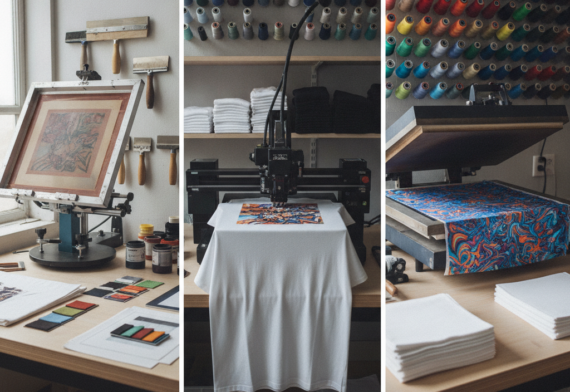
Screen printing is the oldest and most widely used commercial shirt printing method, and for the right project, it remains unmatched in quality and cost-efficiency. Here’s the fast answer: screen printing uses a stencilled mesh screen to press ink directly onto the fabric, layer by layer, one colour at a time. The result is a thick, vibrant print with outstanding durability that survives hundreds of wash cycles without fading.
Because each colour in a design requires its own screen — and those screens take time and materials to set up — screen printing carries an upfront setup cost. That cost is quickly absorbed when you’re ordering in volume. If you’re printing 48 shirts, 100 shirts, or more, screen printing typically delivers the lowest per-unit price of any method. For large orders with simple, bold graphics — a company logo, a team name, an event design — it’s the gold standard.
Where Screen Printing Falls Short
Screen printing is not the right choice for every project. Photographic images, gradients, and designs with dozens of colours become prohibitively expensive when every shade requires its own screen. Small runs under 12 to 24 pieces also rarely make economic sense, since the setup cost doesn’t spread across enough units. And if you need a quick one-off for a presentation or a gift, screen printing’s production timeline may not align with your deadline.
For those situations, there are better options — and that’s exactly where DTG and DTF printing come into their own.
How Does DTG Printing Work — and Is It Right for Your Order?
DTG printing — Direct to Garment — works exactly the way the name suggests: a specialized printer jets water-based ink directly onto the surface of the fabric, much like a desktop inkjet printer works on paper, but engineered for textile. DTG printing is the right call when you need rich, full-colour detail on small quantities without setup fees or colour limitations.
This method genuinely shines for complex artwork: photographic prints, illustrations with gradients, multicolour logos that would cost a fortune to screen print. There are no screens to make, no minimum order quantities to hit, and no extra charge for using twelve colours instead of two. You design it, we print it, and the result is soft to the touch and precise down to fine detail.
The Honest Limitations of DTG
DTG printing performs best on 100% cotton fabrics, particularly in light colours. Printing on dark garments requires a white underbase layer — a preparatory step that adds time and cost, and can affect the softness of the final print. Highly blended or synthetic fabrics may not absorb DTG ink as well, leading to lower vibrancy. And while the per-unit price is reasonable for small runs, it doesn’t scale down as aggressively as screen printing does for large orders.
Our team in Scarborough evaluates every project individually. If a customer brings us a 10-piece order with a photographic design on white cotton shirts, DTG is almost always the recommendation. If the same customer wants 200 pieces with a two-colour logo, the conversation shifts quickly toward screen printing.
What Are DTF Prints — and Why Are They Changing the Industry?
DTF prints — Direct to Film — represent one of the most significant shifts in custom apparel decoration in the past several years. The short version: DTF printing involves printing a design onto a special film, applying a hot-melt adhesive powder, curing it, and then heat-transferring the finished film onto the garment. The result is a vibrant, flexible, durable print that adheres to virtually any fabric type.
What makes DTF prints genuinely exciting is their versatility. Unlike DTG, which needs cotton to perform optimally, DTF works on cotton, polyester, blends, nylon, denim — even leather and canvas. There’s no pretreatment required, no fabric restriction, and no colour limit. A design that would be difficult or expensive on any other method often becomes straightforward with DTF.
DTF vs. DTG: Which Should You Choose?
Both methods handle full-colour, detailed artwork on smaller runs. The deciding factors are usually fabric type and finish preference. DTG produces a slightly softer, more breathable print on cotton because the ink bonds directly with the fibres. DTF produces a slightly raised print — smooth and vivid — that works on a broader range of materials. If your shirts are 100% cotton and you prefer a natural feel, DTG is excellent. If you’re working with performance wear, blended fabrics, or need the same design applied across multiple garment types, DTF is the stronger choice.
At our Scarborough, ON studio, we regularly use DTF for branded apparel projects that involve mixed fabric types — a situation that’s increasingly common as businesses order uniforms, polos, and casual tees in the same run. It’s a method that solves real problems, and we’re proud to offer it as part of our full-service lineup.
| Method | Best For | Fabric Compatibility | Minimum Order | Colour Complexity |
|---|---|---|---|---|
| Screen Printing | Large bulk runs, bold logos | Cotton, blends | 24–48+ pieces (typical) | Limited (cost per colour) |
| DTG Printing | Small runs, photo-quality detail | Best on 100% cotton | No minimum | Unlimited |
| DTF Prints | Mixed fabrics, detailed art | All fabric types | No minimum | Unlimited |
| Sublimation | All-over prints, sportswear | Polyester (light colours) | Varies | Unlimited |
What About Sublimation — Is It the Right Method for All-Over Prints?
Sublimation is the go-to method for all-over printed designs, and for those specific projects, nothing else comes close. Sublimation works by converting dye into a gas using heat, which then bonds permanently with the polyester fibres of the garment. The result is a print that is technically inside the fabric — not sitting on top of it — which means it cannot crack, peel, or fade the way surface prints can.
Sublimation is exceptional for sportswear, performance jerseys, custom uniforms, and any design that needs to wrap edge-to-edge across the entire garment. The colour reproduction is vivid and photographic. Because the dye bonds with the polymer structure of polyester, sublimation works almost exclusively on light-coloured polyester or polyester-blend fabrics — it has little to no effect on cotton and cannot print dark-coloured garments effectively.
For GTA businesses ordering custom athletic gear, team uniforms, or branded activewear, sublimation is frequently the best investment. For everyday t-shirts in cotton, one of the other three methods will serve you better.
How Much Does Custom T-Shirt Printing Actually Cost in the GTA?
Pricing for custom t shirt printing varies significantly depending on method, quantity, design complexity, and garment choice — but that doesn’t mean it has to be a mystery. Here’s what buyers in the GTA can generally expect as they plan their budgets.
Screen printing has setup costs that typically run per screen (per colour), but the per-shirt cost drops sharply as quantity increases. At 100+ units, screen printing frequently offers the most affordable price per piece of any method. DTG and DTF prints carry no setup fees, making them cost-effective for small runs — often starting under $20 to $30 per shirt at low quantities, with pricing that decreases as volume increases. Sublimation pricing depends heavily on the complexity of the all-over design and the garment itself.
One piece of advice we give every customer: don’t evaluate printing cost in isolation. Factor in design, turnaround time, and whether you need delivery. A slightly higher per-unit price from a full-service studio that handles design, printing, and delivery from one location in Scarborough often works out cheaper — and far less stressful — than piecing together three different vendors. We built our service model around exactly that reality.
“The true cost of a print order isn’t just the price per shirt — it’s the time you spend managing vendors, chasing approvals, and correcting mistakes. One trusted studio that handles everything is almost always the smarter investment.”
Why Working With a Local GTA Studio Changes the Entire Experience
Working with a local studio gives you something that no national chain or online-only printer can replicate: a real conversation with the people making your product. When you work with a Scarborough-based studio like ours, you can bring your logo in on a Tuesday and talk to the same person who sets up the print on Wednesday. That continuity matters enormously when you’re dealing with brand colours, specific sizing, or a tight deadline.
We serve businesses across the GTA — from Scarborough to North York, Mississauga to Richmond Hill — and the feedback we consistently hear is that local, personalized service saves time and prevents the kind of costly reprints that happen when an online order goes sideways with no one to call. When something needs to change, we change it. When a customer isn’t sure which method suits their project, we sit down and figure it out together.
Our full-service approach covers everything from initial design and file preparation through to printing and delivery. Whether you need branded apparel, marketing and advertising prints, business essentials, or signage, we manage the entire process under one roof. That’s not a tagline — it’s how we’ve built lasting relationships with small businesses and organizations across the Greater Toronto Area.
If you’re searching for reliable custom printing services in the GTA, explore our full range of offerings at Print Grafix or learn more about who we are and how we work on our About Us page.
What to Prepare Before You Place Your T-Shirt Printing Order
Knowing what to bring to your first conversation with a print studio dramatically speeds up the process and reduces the chance of miscommunication. Before reaching out, it helps to have a clear sense of the following, even if you don’t have final answers on all of them.
Your Design and File Format
Wherever possible, provide your artwork as a vector file — AI, EPS, or PDF formats are ideal. Vector files scale to any size without losing quality, which matters enormously when your logo goes from a business card to a shirt chest print. If you only have a raster file (JPEG or PNG), make sure the resolution is at least 300 DPI at the intended print size. Our design team can assist with file preparation and optimization if needed — we’d rather spend a few minutes fixing a file than send you a print that doesn’t represent your brand accurately.
Quantity, Sizing, and Garment Preferences
Have a realistic estimate of how many shirts you need, broken down by size if possible. Knowing whether you want a specific garment brand, fabric weight, or fit helps us source the right blanks and give you an accurate quote. If you’re flexible on the garment, tell us your budget and what matters most — softness, durability, a specific colour — and we’ll recommend options that fit.
Your Deadline
Be upfront about when you need the finished order in hand — not just when you’d like it, but when you absolutely need it. Our team in Scarborough is known for fast turnaround times, and we’ll always tell you honestly whether your deadline is achievable given current production volume. We’d rather have that conversation at the start than disappoint you at the end.
Ready to Print Apparel You’re Actually Proud Of?
Whether you need a single custom shirt or a full branded apparel run for your entire team, our Scarborough studio is ready to help. From design to delivery, Print Grafix handles the entire process so you don’t have to manage multiple vendors or guess which printing method is right for your project. Get in touch today for a fast, no-pressure quote.
✍️ Written by the Print Grafix Team — Based in Scarborough, ON, our team works directly with small businesses, entrepreneurs, and organizations across the GTA every day. We share what we know because an informed customer always ends up with a better final product.
Frequently Asked Questions
How do I know which shirt printing method is right for my project?
The right method depends on four things: your order quantity, your design complexity, your fabric type, and your budget. Screen printing is typically best for large quantities with simple artwork. DTG printing suits small runs with detailed, full-colour designs on cotton. DTF prints are ideal when you’re working with mixed or synthetic fabrics. Sublimation is the correct choice for all-over designs on polyester garments. When in doubt, share your project details with our team and we’ll recommend the method that delivers the best result for your specific situation.
What file format should I submit for custom t shirt printing?
Vector files — such as AI, EPS, or high-resolution PDF — are the preferred format for any print order because they scale without losing quality. If you’re working with a raster image like a JPEG or PNG, ensure it’s at least 300 DPI at the intended print size. If your file isn’t print-ready, our design team can assist with optimization and preparation as part of our full-service offering at our Scarborough studio.
Why are DTF prints becoming so popular for branded apparel?
DTF prints have gained significant traction because they combine the full-colour flexibility of DTG with the fabric versatility that screen printing and DTG simply can’t match. There are no setup fees, no colour restrictions, no minimum order requirements, and no fabric limitations — DTF adheres to cotton, polyester, nylon, denim, and blended fabrics alike. For small businesses and entrepreneurs who need consistent branding across different garment types, DTF printing is one of the most practical solutions available today.
Can I order a small quantity of custom printed shirts without paying excessive setup fees?
Yes — and this is one of the most common concerns we hear from small businesses and entrepreneurs in the GTA. DTG printing and DTF prints both carry no screen setup fees, which makes them genuinely cost-effective for small runs, including single-piece orders. You pay for the garment and the print, not for screens or plates. If you’re ordering fewer than 24 pieces, DTG or DTF is almost always the more affordable route, and our team at Www.Printgrafix.Ca can walk you through both options with transparent pricing before you commit to anything.