If you’ve been searching for a reliable way to print stickers toronto businesses actually use on packaging, windows, vehicles, and product labels, the options can feel overwhelming. Die-cut or kiss-cut? Vinyl or paper? Gloss or matte lamination? The format you choose affects not just how your sticker looks on day one, but how long it survives on a coffee cup, a storefront window, or the back of a laptop. This guide walks through every major sticker and decal format available through Print Grafix, explains what each is best suited for, and gives you a clear picture of what to prepare before you place your order.
Quick Answer
Custom stickers and decals in Toronto are available in several formats including die-cut, kiss-cut, vinyl decals, roll stickers, and clear labels. For most orders, you need print-ready artwork at 300 DPI with a 1/8-inch bleed. At Print Grafix in Scarborough, turnaround times vary by format and quantity, with rush and same-day options available for select sticker jobs.
What Are the Main Custom Sticker Formats and When Should You Use Each?
The right sticker format depends on the surface it will be applied to, the environment it will face, and how polished you need the finished product to look. Each format has a distinct production process, and choosing the wrong one is an easy mistake that costs time and budget.
Die-Cut Stickers
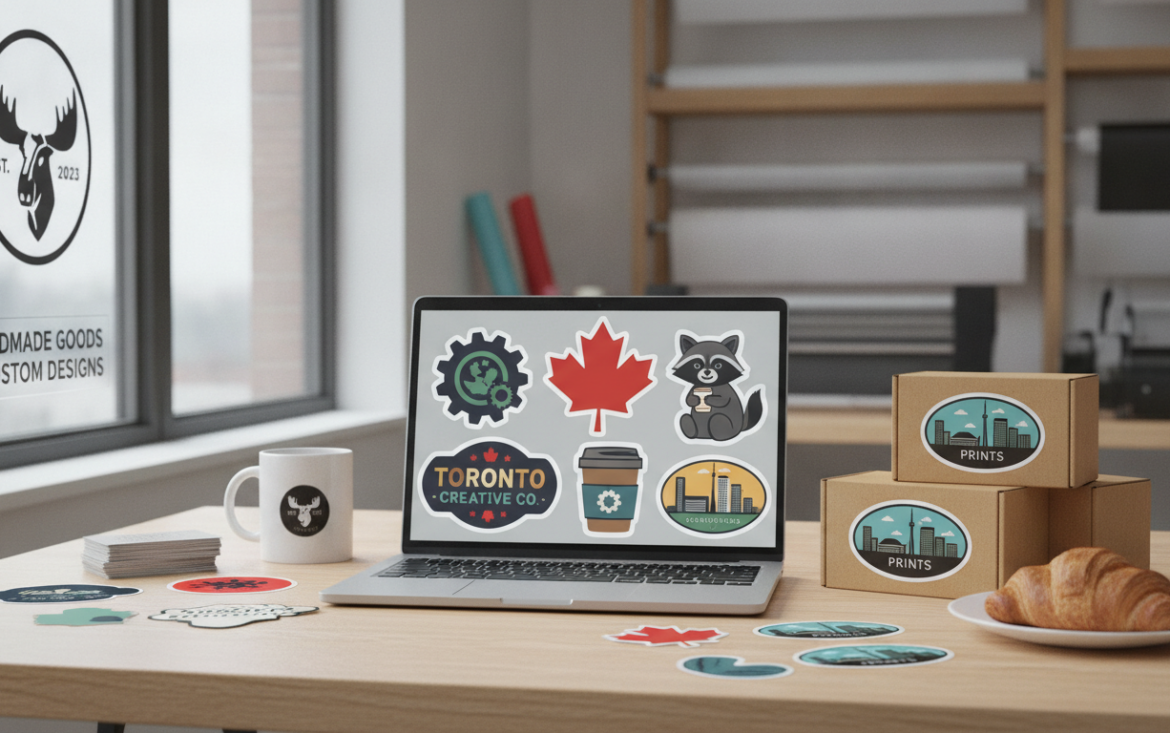
Die-cut stickers are cut precisely to the outline of your artwork, leaving no excess border. The result is a clean, professional shape — a logo, a character, a product badge — where the sticker itself becomes part of the design. These are popular for branded packaging, product labelling, and promotional giveaways because they look intentional rather than mass-produced. Die-cut stickers are printed on durable vinyl or paper stock, depending on whether the application is indoors or exposed to moisture.
Kiss-Cut Stickers
Kiss-cut stickers are cut through the face material only, leaving the backing sheet intact. This makes them easier to peel and hand out, which is why they appear frequently at events, in mailer packages, and as retail merchandise. Because the backing extends beyond the design, you have space to add your website URL, a QR code, or a short brand message — real estate that die-cut stickers don’t offer.
Vinyl Decals
Vinyl decals are cut from solid-colour vinyl film rather than printed, which makes them exceptionally durable outdoors. They adhere to vehicles, windows, walls, and equipment, resisting UV exposure, rain, and temperature swings that would destroy paper-based stickers. Businesses across the GTA use them for fleet branding, storefront window graphics, and equipment identification. If you’ve seen a logo on a service van or a “hours of operation” display on a glass door, that’s almost certainly a vinyl decal. For those searching for printed decals near me in the Scarborough and broader Toronto area, vinyl decals represent one of the most cost-effective long-term branding investments available.
Roll Stickers and Sheet Labels
Roll stickers and sheet labels are the workhorses of product-based businesses. If you’re applying stickers to bottles, boxes, bags, or jars in any volume, rolls are the practical choice because they feed directly through label applicators without manual peeling. Sheet labels are more versatile for lower-volume runs or when you need multiple label designs per sheet. Label printing in this format is especially relevant for food and beverage producers, cosmetic brands, and small manufacturers who need compliant, professional packaging without minimum order quantities that only large print houses can accommodate.
Clear and Transparent Labels
Clear labels are printed on transparent film stock, creating the visual effect of printing directly onto the surface beneath. They’re a favourite for glass bottles, jars, and product packaging where a “no-label look” reinforces a premium feel. Clear labels require slightly higher contrast in your artwork to remain legible, particularly if the substrate colour is light. Our team at Print Grafix can advise on artwork adjustments before going to press.
| Format | Best Use | Typical Material | Indoor / Outdoor |
|---|---|---|---|
| Die-Cut | Branded giveaways, product badges | Vinyl or gloss paper | Indoor / Light outdoor |
| Kiss-Cut | Events, mailers, merchandise | Gloss or matte paper | Indoor |
| Vinyl Decal | Vehicles, windows, equipment | Cast or calendered vinyl | Indoor and outdoor |
| Roll / Sheet Label | Product packaging, food labels | Paper, vinyl, or clear film | Indoor / Refrigerated |
| Clear Label | Premium bottles, jars, glass | Transparent BOPP film | Indoor |
How Do You Set Up Artwork for Custom Sticker Printing?
Artwork setup is the step most clients underestimate, and it’s also the step most responsible for delays or reprints. Supplying files correctly the first time is the fastest path to a clean finished product.
Resolution and File Format
All artwork should be supplied at a minimum of 300 DPI at the final print size. Files created at 72 DPI (screen resolution) will print soft and pixelated regardless of how sharp they appear on your monitor. Preferred file formats are PDF, AI (Adobe Illustrator), or EPS with all fonts converted to outlines. High-resolution PNG files are acceptable for straightforward designs, but vector formats are always preferable because they scale without quality loss.
Bleed, Safe Zone, and Cut Lines
For stickers with a printed background that extends to the edge, add at least 1/8 inch (3mm) of bleed beyond the cut line. This prevents white slivers from appearing if the cut shifts slightly during production. Keep all critical content — text, logos, barcodes — at least 1/8 inch inside the cut line, within the safe zone. For die-cut and kiss-cut stickers, include a separate cut path layer in your file, clearly labelled. If you don’t have this, our team can create it from your artwork, though that may add a small pre-press step to your timeline.
Colour Mode
Stickers are printed in CMYK, not RGB. Files built in RGB will be converted during the ripping process, and colours — especially vibrant blues, oranges, and greens — can shift noticeably. Convert your file to CMYK before submitting and do a soft proof on a calibrated monitor if colour accuracy is critical to your brand. Pantone spot colours can be matched on certain vinyl decal runs; ask us at the time of quoting if brand colour fidelity is a priority.
Supplying a print-ready CMYK PDF with bleed included is the single most effective thing a client can do to speed up turnaround and avoid a reprint. It removes every pre-press variable from the equation.
What Finishes Are Available and Why Do They Matter?
The finish you choose affects both the visual character of your sticker and its practical durability. Gloss and matte are the two standard options, and each serves a distinct purpose.
Gloss lamination adds a reflective coating that makes colours appear richer and more saturated. It also adds a layer of physical protection against scuffs, moisture, and handling. Gloss-finished stickers look sharp on product packaging and in retail environments where visibility under lighting matters. Matte lamination produces a soft, non-reflective surface that reads as more understated and premium. It photographs better, resists fingerprints, and is the go-to choice for cosmetics, boutique food brands, and anything where a “quiet luxury” feel is the goal.
UV spot coating is a third option available on select runs: a high-gloss varnish applied to specific areas of the design — a logo mark, a product name — while the rest of the sticker remains matte. The contrast between the two surfaces creates a tactile, premium effect that stands out in crowded retail environments.
For outdoor and vehicle applications, lamination is not optional — it’s protective. UV exposure degrades uncoated inks rapidly. A properly laminated vinyl decal applied to a vehicle exterior can maintain its colour and adhesion for several years under normal Canadian conditions.
Clients in the Richmond Hill area frequently ask about lamination as a standalone service for existing printed materials — protecting menus, signage inserts, and display cards. This is a standard part of our custom printing toronto service offering and can be arranged alongside or separately from a sticker order.
How Fast Can You Get Custom Stickers Printed in Toronto?
Turnaround depends on the format, quantity, and whether your artwork arrives print-ready. For standard small-format stickers on paper or vinyl stock, same day sticker printing toronto is achievable when files are submitted early in the business day and quantities are within a reasonable run size. Rush orders are a regular part of what we do at Print Grafix — not a special exception.
For custom die-cut and kiss-cut formats, additional time is typically needed for cut-path processing and machine setup, particularly on first-time designs. Clear and specialty film labels also carry slightly longer lead times because of the material handling involved. The honest rule of thumb: standard formats with ready artwork can turn around in one to two business days; complex specialty formats realistically require three to five.
If your timeline is critical, communicate it upfront. Our team will confirm feasibility before accepting the job rather than overpromise and underdeliver. For clients in Scarborough, same-day pickup is available on eligible orders, which removes courier time from the equation entirely.
The fastest way to slow down any sticker order is submitting artwork that requires significant correction. Files that arrive as low-resolution JPEGs, in RGB colour mode, or without bleed add pre-press time that eats directly into production hours. Submitting correct files is genuinely the most effective way to control your own turnaround.
Our broader custom printing capabilities extend well beyond stickers. If your project also includes larger format output, our team has covered the full scope of Large Format Printing in Toronto: Trade Show Displays, Wall Graphics, and Event Signage Made Easy, which is worth reviewing if your campaign spans multiple print formats.
Why Work with a Local Print Studio Instead of an Online Print Broker?
Online print brokers offer convenience, but they create distance between you and the actual production process. When a problem occurs — wrong colour, incorrect cut, damaged shipment — the resolution path runs through a customer service queue, not a conversation with the person who ran your job. That difference matters most when your timeline is tight.
Working with a local studio like Print Grafix in Scarborough means your artwork is reviewed by a real pre-press team before it goes to press. If your cut path is missing or your resolution is marginal, we tell you before the job runs — not after a shipment arrives from a warehouse three provinces away. That pre-press relationship catches the kind of errors that online automated systems simply pass through to production.
For small businesses and entrepreneurs across the GTA, that accountability carries real value. You’re not locked into enterprise contracts or large minimum quantities. You can order what you need, adjust quantities as your business evolves, and get consistent quality because the same team handles your files every time.
Sticker and decal printing is also just one part of the picture for most growing businesses. The same client who needs roll labels for a product line often also needs business cards, flyers, banners, or branded apparel. Having all of that handled through one trusted vendor — from design through to delivery — reduces coordination overhead significantly. That integrated approach is a core part of how we operate.
For businesses that need other quick-turnaround print services beyond stickers, it may also be worth reviewing Same-Day Cheque Printing: What Toronto Businesses Need to Know Before Ordering — a resource that walks through the same kind of turnaround expectations for another time-sensitive print product.
The GTA printing market has no shortage of vendors. What it has a shortage of is vendors who treat a 250-sticker order with the same care as a 50,000-unit run. That’s the difference a local, personalized studio makes in practice, not just in marketing language.
Ready to Print Stickers, Labels, or Decals in Toronto?
Whether you need a short run of die-cut stickers for an upcoming product launch, vinyl decals for a vehicle or storefront, or roll labels for packaging, our team at Print Grafix is ready to help. We serve small businesses and entrepreneurs across Scarborough and the broader GTA with competitive pricing, fast turnaround, and no enterprise minimums. Submit your artwork or request a quote today.
About the Author: This article was written by the Print Grafix team, a Scarborough-based printing studio serving small businesses, entrepreneurs, and organizations across the GTA. We specialize in branded print solutions — from custom stickers and labels to signage, apparel, and business essentials — with a hands-on approach to every project we take on.
Frequently Asked Questions
How do I know which sticker format is right for my project?
Start with the surface and environment. If your sticker will be on a vehicle, window, or exposed to weather, vinyl decals or laminated vinyl stickers are the correct choice. For product packaging and labels applied indoors, paper or BOPP film labels work well. For promotional giveaways or events, kiss-cut stickers on a backing sheet are the most practical format. If you’re unsure, describe your application to our team and we’ll recommend the right material and finish before you commit.
What file formats do you accept for custom sticker printing?
We accept PDF, AI, EPS, and high-resolution PNG or TIFF files. All files should be in CMYK colour mode at 300 DPI or higher, with bleed included where the design extends to the edge. Vector formats (PDF, AI, EPS) are preferred because they scale without quality loss and allow precise cut-path control for die-cut and kiss-cut orders.
Why does colour sometimes look different on the printed sticker compared to my screen?
Monitors display colour in RGB, which has a wider gamut than the CMYK inks used in commercial printing. When an RGB file is converted to CMYK during the print process, saturated colours — particularly vivid blues, greens, and oranges — can appear less vibrant on the finished product. Converting your file to CMYK before submission and reviewing a soft proof lets you see and adjust the colour before the job runs, eliminating surprises.
Can I order a small quantity of custom stickers without a large minimum order?
Yes. At Print Grafix, we work with small businesses and entrepreneurs who regularly need short runs — whether that’s 50 product labels for a market launch or 100 die-cut stickers for an event. We don’t require enterprise-scale minimums, and our pricing is structured to make smaller quantities genuinely affordable. Contact us with your specs and quantity, and we’ll provide a straightforward quote with no obligation.
Written by the Print Grafix Team
Our team brings deep expertise — We provide printing services.