Why Offset Printing Still Matters for GTA Businesses
Most small business owners encounter the term offset printing at some point, usually when they are getting quotes for a larger print run and suddenly the numbers start to look very different depending on which process a print shop is using. If you have ever wondered what that difference actually means in practice, you are not alone. It is one of the most asked-about topics our team fields from clients across the GTA, from startups in Scarborough getting their first round of branded collateral printed to established businesses ordering seasonal marketing materials in volume.
Understanding offset printing is not about memorizing a technical process. It is about knowing when it serves your project and when it does not, so that you spend your print budget where it delivers the most value. This article covers exactly that: what offset printing is, how it compares to digital printing, what kinds of projects benefit from it, and how businesses across Toronto and the surrounding area can access it through a local, full-service provider.
Quick Answer
Offset printing is a high-volume commercial printing process that transfers ink from a metal plate to a rubber blanket and then onto the substrate. It produces exceptionally consistent colour and sharp detail at scale, and its per-unit cost drops significantly as quantities increase. For most GTA businesses, offset printing makes the most sense for runs of 500 pieces or more, particularly for brochures, flyers, marketing collateral, and business essentials where colour accuracy and paper quality are priorities.
What Is Offset Printing and How Does It Work?
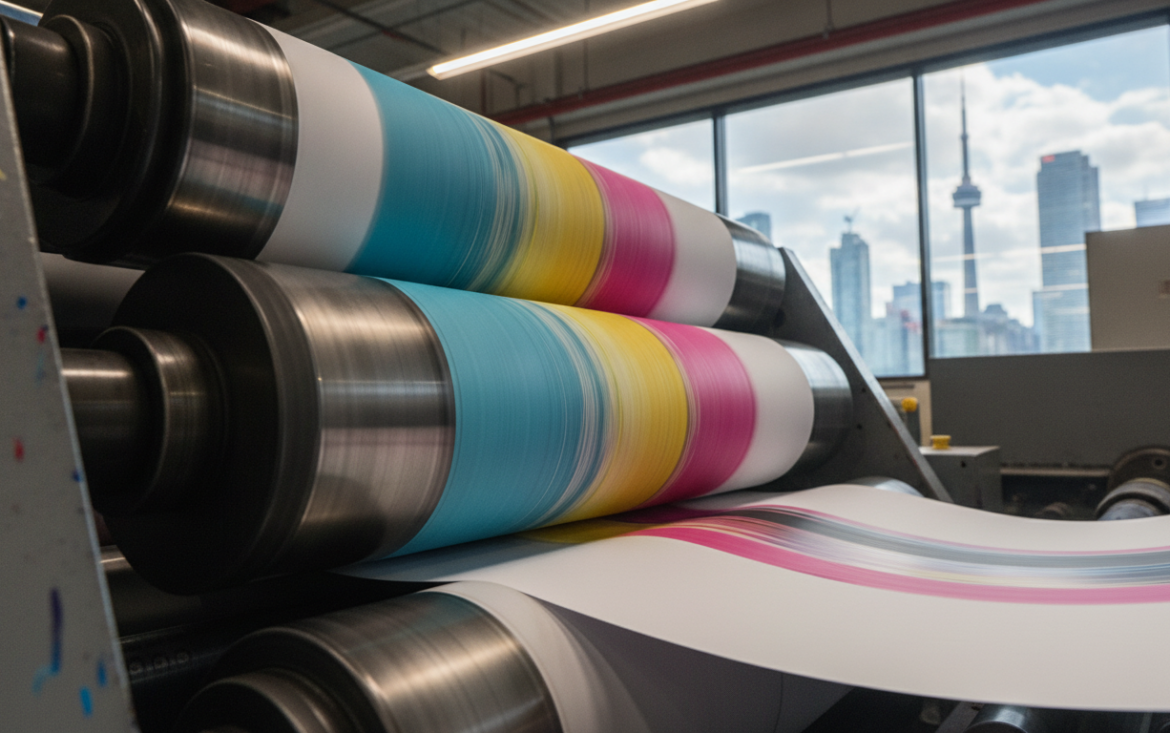
Offset printing is a process where the image to be printed is first transferred onto a metal plate, usually aluminium. That plate is then mounted on a cylinder inside the press. When the press runs, the plate picks up ink in the areas that correspond to the printed image and transfers it to a rubber blanket, which then presses the image onto the paper or substrate moving through the machine. Because the plate never touches the substrate directly, the process is sometimes called indirect printing. The rubber blanket conforms closely to the surface of the material, which is part of why offset produces such clean, consistent results even on textured stock.
Each ink colour requires its own plate. For full-colour printing, four plates are used: one each for cyan, magenta, yellow, and black. This is the standard CMYK process you will see referenced across the print industry. Some specialty jobs add extra plates for Pantone or spot colours, which is how brands achieve specific colour matches that CMYK alone cannot reliably reproduce. This flexibility makes offset printing particularly valuable for brand-sensitive work where colour consistency across thousands of pieces is non-negotiable.
The setup cost — producing the plates and calibrating the press — is a fixed expense regardless of how many pieces you print. This is the fundamental economic logic of offset: once the press is running, the marginal cost of each additional sheet is very low. At low quantities, that fixed setup cost makes offset more expensive per unit than digital. At higher quantities, the equation flips, and offset becomes the more cost-effective option by a significant margin.
How Does Offset Printing Compare to Digital Printing?
Digital printing and offset printing are both legitimate, high-quality processes — the right choice depends on your quantity, timeline, and project requirements, not on one being universally better than the other.
Digital printing works more like a large, sophisticated laser or inkjet printer. Files are sent directly to the press without any plate-making step, which means there is no setup cost and no minimum run. You can print one copy or one hundred for essentially the same per-unit cost. That makes digital the preferred process for short runs, quick proofs, variable data printing (where each piece has a personalized name or address), and jobs where turnaround time matters more than price per unit. At Print Grafix, our digital printing capabilities allow us to serve clients who need fast turnaround on smaller quantities of business cards, flyers, brochures, and marketing materials.
Offset printing requires that plate-making step, which adds time and an upfront cost. But once the press is running, the output is exceptionally consistent, and the colour richness achievable on offset — particularly when printing on uncoated stocks or using spot colours — is difficult to match digitally. For businesses ordering 500, 1,000, or 5,000 flyers, the per-unit cost on offset can be meaningfully lower, and the finished quality often shows it.
| Attribute | Offset Printing | Digital Printing |
|---|---|---|
| Setup Cost | Higher (plate production required) | None (file sent directly to press) |
| Ideal Quantity | 500+ pieces (cost advantage scales up) | 1–500 pieces (cost stays predictable) |
| Colour Consistency | Exceptional, especially for spot/Pantone | Very good for CMYK, variable by press |
| Turnaround Time | Longer (plate setup adds time) | Faster, same-day options available |
| Substrate Options | Wide range including specialty stocks | Good range, some limitations on specialty |
| Variable Data | Not practical (plate change required) | Fully supported (ideal for personalization) |
| Per-Unit Cost at Scale | Decreases significantly with volume | Remains relatively flat regardless of run |
For a deeper side-by-side look at which process suits different project types, our guide on Offset Printing vs. Digital Printing: Which Is Right for Your Next Print Run? walks through the decision in more detail.
What Types of Projects Is Offset Printing Best Suited For?
Offset printing excels on projects where volume, colour fidelity, and substrate versatility all matter at once. The projects below are where offset consistently delivers a clear advantage over digital alternatives.
Flyer and Brochure Printing at Volume
Businesses running seasonal promotions, community campaigns, or event-driven marketing often need flyers and brochures in the thousands. At those quantities, offset printing brings the per-unit cost down to a range that makes wide distribution financially practical. If you are preparing a campaign for a neighbourhood across Scarborough or distributing collateral through partner businesses across the GTA, offset gives you the volume you need without inflating your cost per piece.
Business Essentials and Stationery
Letterheads, envelopes, notepads, and presentation folders are often ordered in quantities where offset makes economic sense. These are materials your team uses every day and that clients handle, so quality is visible and matters. Offset printing on quality paper stocks produces a tactile and visual result that reflects well on your brand. Business card printing is another common use case, particularly for companies ordering full-box quantities or coordinated sets across multiple team members.
Marketing and Advertising Collateral
Catalogues, product sheets, sell sheets, and direct mail pieces are strong candidates for offset printing. When you are mailing to a large list or leaving materials at multiple retail or business locations, the economics of offset compound: more pieces, lower cost per piece, and a finished product that holds up well through handling and mailing processes.
Specialty Substrates and Finishing
Offset presses handle a wide range of paper weights, coated and uncoated stocks, and specialty substrates. When combined with post-press finishing options like spot UV coating, foil stamping, embossing, or lamination, offset produces results that position printed materials as premium assets rather than functional necessities. For branded gifts, packaging inserts, or high-end marketing pieces, this combination of process and finishing is hard to beat.
“The right printing process is not about prestige — it is about matching the method to the project. Offset printing earns its place when volume, colour, and substrate quality all need to work together at a price point that makes sense for the business.”
Why Minimum Run Size and Unit Cost Are the Core Business Case
The economic argument for offset printing rests on a simple principle: fixed costs spread over more units become smaller. The plate-making and press setup costs are real and unavoidable, but once absorbed across a large run, they add very little to each individual piece’s cost. A business printing 5,000 flyers on offset will pay a fraction per piece of what it would pay for 500 on the same process, and may well pay less per piece than digital at that quantity too.
Most commercial print shops, including our team at Print Grafix, set their offset minimums based on the economics of press setup. Common starting points for offset runs are around 500 to 1,000 pieces, though this varies by product type and press configuration. Below that threshold, digital printing is typically both faster and more cost-effective. Above it, offset pricing tends to drop in a way that makes volume printing genuinely affordable for businesses that are not operating at enterprise scale.
For small businesses and organizations that have historically assumed offset printing was out of their reach, working with a local printing services provider in Toronto and the GTA region changes that assumption. You do not need to be a large corporation with procurement contracts to access offset printing. You need a project with sufficient volume and a print partner who can walk you through the options without overcomplicating the conversation.
How to Order Offset Printing Through a Local GTA Provider
Ordering offset printing locally is straightforward when you work with a full-service provider who handles the process from file preparation through to delivery. Here is how the typical workflow looks when our team manages a project.
Step One: Define Your Project Parameters
Before anything else, you need a clear picture of what you are printing, how many copies you need, what size and format you require, and what your deadline is. The more specific you can be, the more accurate your quote will be. Product type (flyer, brochure, business card, etc.), quantity, paper stock preference, and any finishing requirements (lamination, coating, scoring, binding) are the key variables.
Step Two: Prepare or Submit Your Files
Offset printing requires print-ready files, typically PDF format with proper bleed, crop marks, and colour profiles set to CMYK. If your files are not press-ready, our design team can prepare them or refine existing artwork to ensure the final output matches your expectations. This is part of the full-service approach that distinguishes a local studio from an online print portal where files are uploaded with no human review.
Step Three: Review a Proof
Before plates are made, you will review a digital proof that shows how your design will appear in print. This is your opportunity to confirm colours, layout, and content. For colour-critical work, a press proof on the actual substrate can be arranged, though this adds time and cost and is typically reserved for large or premium jobs.
Step Four: Production and Delivery
Once the proof is approved, plates are produced and the job goes to press. Post-press finishing, cutting, and packaging follow. Delivery or pickup is arranged based on your timeline. Working with a Scarborough-based print shop means you have the option of local pickup for time-sensitive orders, which removes the uncertainty of transit times that come with sending files to out-of-town or online-only printers.
If your project also involves signage, branded apparel, or large format printed materials alongside your offset print run, our team can coordinate all of it together. For context on how large format printing fits into broader campaign planning, our article on Banner Printing: Sizes, Materials, and How to Order for Your Next Event or Promotion covers those decisions in practical detail. And if you are still weighing whether local custom printing is the right choice compared to other fulfillment models, Print-on-Demand Gifts vs. Local Custom Printing: Which Delivers Better Value? addresses that question directly.
What Makes a Local Print Shop the Right Partner for Offset Work?
Working with a local provider for offset printing is not just a matter of convenience. It is about accountability and communication at every stage of a job where the stakes are higher than a short digital run.
When you place an offset printing order with a studio that knows your business, you get a conversation rather than a submission form. Our team at Print Grafix works directly with clients across the GTA to understand what a project needs to accomplish, not just what specs to plug into a system. That means catching issues before plates are made, recommending paper stocks that suit the application, and advising on finishing options that add value rather than cost for its own sake.
For businesses in Scarborough and across the broader GTA region looking for custom printing that covers everything from business essentials to large marketing campaigns, having one trusted provider handle design, printing, and delivery reduces the coordination overhead that comes with managing multiple vendors. Custom printing Toronto clients can access through Print Grafix spans the full range of commercial print formats, so a business does not need to piece together a supply chain from several separate suppliers.
The print industry has changed significantly with the growth of online print portals, but the case for local remains strong for jobs where quality, timing, and accuracy are all critical. Offset printing is exactly that kind of job. The investment in setup means there is real cost exposure if something goes wrong, and having a local team you can reach, visit, and hold accountable protects that investment in a way that a purely transactional online relationship does not.
Ready to Start Your Next Print Run?
Whether you are planning a high-volume flyer campaign, a full suite of business essentials, or branded marketing materials for a product launch, our team is ready to help you get it right. We work with businesses across Scarborough, the GTA, and beyond to deliver offset and digital printing with competitive pricing and genuine personal service.
About the Author
The Print Grafix Team is a group of print and design professionals based in Scarborough, ON, serving small businesses, entrepreneurs, and organizations across the Greater Toronto Area. We write from hands-on experience across offset printing, digital printing, large format, branded apparel, and business essentials, so our advice reflects what actually works in the real world of commercial print production.
Frequently Asked Questions
What is the minimum quantity required for offset printing?
Most offset printing jobs start at around 500 to 1,000 pieces, though the exact minimum depends on the product type and the specific press being used. Below that threshold, digital printing is usually the better fit because there are no setup costs and the per-unit price remains consistent at low quantities. If you are unsure which process suits your quantity, sharing your project details with our team will get you a clear recommendation quickly.
How long does an offset printing job typically take?
Turnaround times for offset printing are longer than digital because plate production and press setup add steps to the workflow. A standard offset job generally takes several business days from approved proof to delivery, with the exact timeline depending on quantity, finishing requirements, and current production schedules. If your deadline is tight, digital printing can often accommodate same-day or next-day turnaround on smaller runs. Our team can advise on the fastest option for your specific situation.
Why does offset printing produce better colour consistency than digital at high volumes?
In offset printing, each colour is applied from a dedicated plate that lays down a precise, uniform layer of ink across every sheet. This mechanical consistency means the 5,000th sheet off the press looks essentially identical to the first. Digital printing relies on toner or inkjet technology that can experience minor variation over a long run, particularly on colour-critical work. For projects where matching a brand colour across thousands of pieces is essential, offset provides a level of consistency that is difficult to replicate digitally.
Can I use offset printing for business cards and flyers at the same time?
Yes, and many businesses do exactly this when they are preparing a full suite of collateral at once. Combining multiple products in a single offset print order can sometimes reduce the overall cost by sharing setup time and press configuration across related jobs. Our team can review your full list of required materials and recommend whether running them together on offset or handling some items digitally makes the most practical and financial sense for your project.
Written by the Print Grafix Team
Our team brings deep expertise — We provide printing services.