If you’ve spent weeks on a painting, a photography series, or a mixed-media piece, the last thing you want is a reproduction that flattens your colours, blurs your detail, or fades within a year. Art printing in Toronto has come a long way, and local artists no longer need to ship files overseas or settle for consumer-grade photo labs to get professional results. At Print Grafix, we work directly with creatives across the GTA — from illustrators in Scarborough, ON to photographers downtown — helping them translate digital files and original artwork into high-fidelity printed pieces that honour the original work.
Quick Answer
To get museum-quality art reproductions in Toronto, you need a print studio that offers calibrated colour output, archival-grade paper options, and large format capabilities. Work with a local provider like Print Grafix who can review your files, match your colour profile, and produce prints at the size your work demands — without shipping delays or impersonal online portals.
What Makes a Fine Art Reproduction “Museum Quality”?
A museum-quality reproduction is one that accurately preserves colour, tonal range, and fine detail from the original work while using archival materials that resist fading over time. It is not simply a high-resolution print — it is the result of a deliberate process involving proper file preparation, calibrated output, and the right substrate for the specific artwork.
When artists and photographers talk about fine art output, they’re usually referring to a few non-negotiable standards. First, the colour gamut must be wide enough to reproduce deep shadows and subtle highlights without banding or posterization. Second, the paper or substrate must be acid-free and rated for longevity. Third, the resolution of the source file must be sufficient for the intended print size — typically a minimum of 300 DPI at the final output dimensions.
Many artists are surprised to learn that the printer’s colour profile matters as much as their own monitor calibration. If your studio screen is set to sRGB and your print provider outputs in a different colour space without converting properly, the result can look washed out or oversaturated — even from a perfect file. This is where working with a local print studio pays off. You can review a proof in person, make adjustments on the spot, and avoid the guesswork of ordering online.
Colour Profiles: sRGB vs. Adobe RGB vs. CMYK
Most digital cameras and editing software default to sRGB, which covers a moderate range of colours and is suitable for screen display. Adobe RGB captures a wider gamut, particularly in greens and cyans, making it preferred for photography intended for print. CMYK is the native colour mode for most commercial printing processes, and converting from RGB to CMYK before submitting your file gives you more predictable results.
Our team at Print Grafix recommends submitting files in the highest-quality format available — typically a flattened TIFF or a layered PDF — and discussing the colour profile with us before the job goes to press. A five-minute conversation at the front end saves significant time and cost compared to reprints caused by colour drift.
What Paper and Substrate Options Should Artists Know About?
The substrate you print on is one of the most significant factors in the final look and longevity of an art reproduction. Different surfaces interact with ink in fundamentally different ways, and the right choice depends on the character of the original work and the intended display environment.
For photo printing in Toronto, photographers most commonly choose between glossy, lustre (semi-gloss), and matte finishes. Glossy surfaces produce vivid, high-contrast images with deep blacks — ideal for commercial photography and bold graphic work. Lustre offers a middle ground: sharp detail and good colour saturation without the reflective glare that makes gallery display difficult. Matte surfaces suit painterly photography and fine art work where texture and a non-reflective finish support the aesthetic.
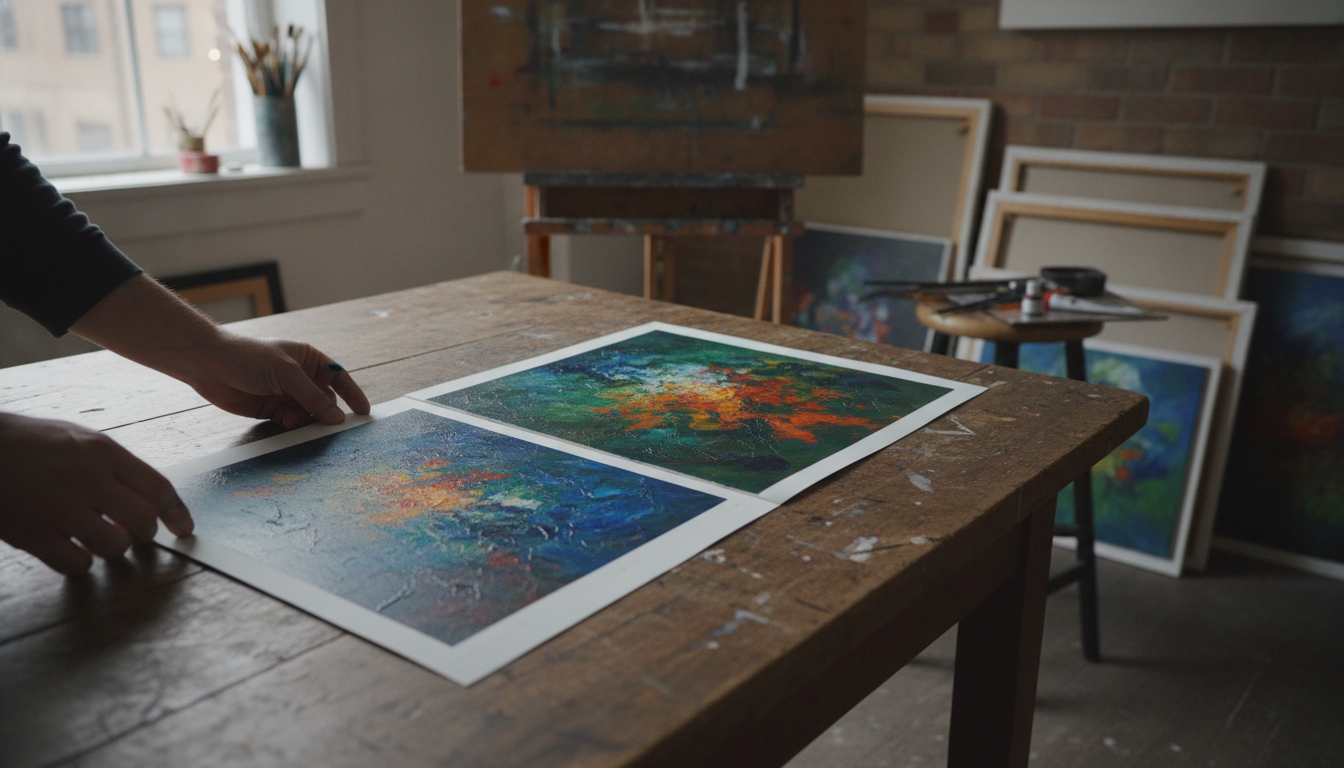
For artists reproducing paintings or illustrations, cotton rag and canvas substrates are worth considering. Cotton rag paper has a slight texture that mimics traditional art paper and absorbs ink in a way that produces rich, painterly tones. Canvas reproductions can be stretched over a frame for a gallery-ready presentation without glass.
Beyond paper and canvas, rigid substrates like foam board, Dibond aluminum, and PVC board are increasingly popular for both display and durability. Mounting a photographic print on aluminum, for example, produces a sleek, contemporary look and eliminates the need for framing. These options also hold up well in high-traffic or outdoor-adjacent environments.
| Substrate | Best For | Finish Options | Gallery/Display Suitability |
|---|---|---|---|
| Glossy Photo Paper | Commercial photography, bold graphics | High gloss | Moderate — reflective under gallery lighting |
| Lustre / Semi-Gloss Paper | Portraits, fine art photography | Semi-gloss with texture | High — reduced glare, strong detail |
| Matte Art Paper | Illustrations, painterly photography | Non-reflective matte | Excellent — no glare, gallery standard |
| Cotton Rag / Fine Art Paper | Painting reproductions, limited editions | Textured matte | Excellent — archival, collector-grade |
| Canvas | Gallery wraps, stretched reproductions | Matte textured | Excellent — frame-free display |
| Aluminum / Dibond | Modern display, high-traffic environments | Gloss or brushed metal | High — durable, contemporary aesthetic |
How Does Large Format Printing Work for Art Reproductions?
Large format printing uses wide-format inkjet printers capable of producing output at widths that far exceed standard desktop or office equipment — typically from 24 inches up to several feet wide. For fine art reproduction, this technology is essential because many original works exist at a scale that simply cannot be represented at smaller print sizes.
Large format printing in Toronto is increasingly accessible to independent artists and small creative studios, not just advertising agencies and large retailers. At Print Grafix, we use large format output for everything from oversized photographic prints to stretched canvas reproductions and rigid board mounting — giving artists the same scale and visual impact as the original.
One common concern among artists ordering at large scale is resolution. A file that looks sharp at 8×10 inches may appear soft or pixelated at 24×36. The rule of thumb is that your file should be at least 300 DPI at the final print size for close-viewing applications. For pieces viewed from a greater distance, 150 DPI at output size is often sufficient. Our team will assess your file before printing and flag any resolution issues so there are no surprises when the print comes off the press.
Large format printing also intersects with the broader world of signage. If you need display prints for a gallery opening, an art market booth, or an exhibition installation, the same large format capabilities that produce fine art output also apply to banners, backdrops, and display panels. You can read more about those applications in our guide on Sign Printing in Toronto: How to Choose the Right Format, Material, and Size for Your Business.
Sizing Your Reproduction: Common Formats and Practical Considerations
Artists producing limited edition prints typically work in a range of standardized sizes that frame easily — 8×10, 11×14, 16×20, 18×24, and 24×36 inches are the most common in North American markets. If you’re selling reproductions through galleries or online platforms, sticking to standard sizing reduces the cost barrier for buyers who want to frame the work themselves.
Custom sizing is also available for artists whose work has an unconventional aspect ratio — a panoramic photograph or a triptych, for example. The key is to communicate your exact dimensions early in the process so paper waste is minimized and cost is calculated accurately. Our team at Print Grafix works with artists to plan run sizes and dimensions in a way that balances quality with practical cost management.
Why Working with a Local Print Studio Makes a Difference
Working with a local print studio gives artists direct access to the people producing their work — which translates to better communication, faster corrections, and results that reflect the artist’s intent rather than a generic automated process. Ordering fine art reproductions through an online print portal means your file goes into a queue with no opportunity for a pre-press review or in-person proofing.
At Print Grafix, based in Scarborough, ON, we take a personalized approach to every project. When an artist or photographer brings us a job, we review the file, discuss the intended display environment, and talk through substrate options before anything goes to press. That conversation — which takes a few minutes in person or over the phone — is often the difference between a print that looks right and one that requires a reprint.
Fast turnaround is another genuine advantage of local printing. Art markets, gallery openings, and exhibition deadlines don’t always allow for a week of shipping time. Our team is set up to move quickly when a project requires it, without sacrificing quality in the process. For creatives across the GTA who need reliable, responsive service, proximity matters.
A print that accurately represents your work is a direct extension of your creative reputation. At Print Grafix, we treat every reproduction as if it were going into a gallery, because for many of our clients, it is.
Custom printing in Toronto spans a wide range of industries and applications, but fine art reproduction has its own specific demands. Artists need a partner who understands those demands — not just technically, but in terms of respecting the work itself. That is the commitment we bring to every art and photography print job we handle.
How to Prepare Your Files and Work With a Print Studio Effectively
Preparing your files correctly before submitting them is the single most effective thing you can do to ensure a smooth print run. Poor file preparation — low resolution, incorrect colour profiles, insufficient bleed — is the root cause of most print quality issues, and it is entirely avoidable with a bit of planning upfront.
Here is a practical checklist for artists submitting fine art reproduction files:
Resolution: At least 300 DPI at the final print dimensions. For very large format work viewed from a distance, 150 DPI may be acceptable — confirm with your print provider.
File format: TIFF (uncompressed) or high-quality PDF are preferred. JPEG files introduce compression artifacts that become visible at larger sizes.
Colour profile: Include your colour profile information in the file, or convert to CMYK before submission. If you work in Adobe RGB, alert your print provider so the conversion is handled correctly.
Bleed: For prints that will be trimmed to a specific size, include at least 3mm of bleed on all sides to prevent white edges after cutting.
Proofing: Request a proof — either a physical print or a calibrated soft proof — before approving the full run. This is especially important for limited edition work where every copy counts.
Artists producing work for sale — through galleries, online shops, or art markets — should also think about consistency across a print run. If you’re printing an edition of 50, the 50th print should match the first. This is why print settings are locked and documented at the start of a job, not adjusted mid-run.
For creatives who also need display materials to accompany their work — booth banners for art markets, promotional signage for gallery openings — our large format capabilities cover those needs as well. See our detailed guide on Banner Printing: Sizes, Materials, and How to Order for Your Next Event or Promotion for practical guidance on those formats.
Artists who also sell branded merchandise — prints on fabric, tote bags, or accessories — may find our apparel printing services useful alongside fine art output. Custom printing for creatives extends well beyond paper, and having a single local vendor who can handle both simplifies the production process considerably.
If you’re curious about how specialty printing methods work for fabric and apparel alongside your art print needs, our guide on Silkscreen Printing Explained: How the Process Works and When It’s the Right Choice is a helpful starting point.
The GTA’s creative community is active and growing, and local print production capacity has grown alongside it. Artists in Scarborough, ON and across the region no longer need to look outside the city for the kind of quality and service that fine art reproduction requires. The expertise, the equipment, and the personal attention are available locally — and the results speak for themselves.
Ready to Print Your Artwork at the Quality It Deserves?
Our team at Print Grafix works with artists and photographers across the GTA to produce fine art reproductions that are faithful to the original work. From substrate selection and colour profile review to large format output and fast turnaround, we handle every detail with care. Bring us your files and let’s talk about what your work needs.
Written by the Print Grafix Team — We are a full-service local printing studio based in Scarborough, ON, serving small businesses, creatives, and organizations across the Greater Toronto Area. From fine art reproductions and photo printing to large format displays and branded apparel, we bring a hands-on, personalized approach to every print project we take on.
Frequently Asked Questions
How do I ensure my artwork colours print accurately?
The most reliable way to ensure colour accuracy is to submit a properly colour-profiled file — ideally in Adobe RGB or CMYK — and request a proof before approving the full run. Working with a local print studio like Print Grafix allows you to review the proof in person and approve it against your original, which eliminates the uncertainty that comes with purely online ordering. Monitor calibration also plays a role: if your screen is not calibrated, what you see on screen will not reliably match what comes off the press.
What file resolution do I need for large format art prints?
For large format art prints intended for close viewing — such as gallery walls or framed display — your file should be at least 300 DPI at the final output dimensions. For prints that will be viewed from a greater distance, such as exhibition backdrops or booth displays, 150 DPI at output size is generally sufficient. If your file falls short, our team will flag it before the job runs so you can decide how to proceed rather than discovering the issue after printing.
Why should I choose a local print studio over an online print service?
A local print studio offers pre-press file review, in-person proofing, and direct communication with the people handling your job — none of which are available through automated online portals. For fine art reproduction, where colour accuracy and substrate choice have a direct impact on the perceived quality of the work, that human involvement is valuable. Local printing also means faster turnaround, no cross-country shipping delays, and the ability to make quick adjustments without starting the process over from scratch.
Can I order a small edition run of fine art prints through Print Grafix?
Yes. Print Grafix works with artists producing limited edition runs of varying quantities. Whether you need five prints for a gallery show or fifty for an online shop, we approach each run with the same attention to consistency and quality. We document print settings at the start of the job so that every piece in the edition matches, and we can accommodate custom sizing and substrate choices to suit the specific demands of your work. Reach out to our team to discuss your project requirements before you need them in hand.